
Barbilophozia hatcheri
| Common Name | Hatcher's Pawwort |
| Quick & Dirty ID | Red Gemmae Four Lobes |
Image Gallery


Distinguishing Features
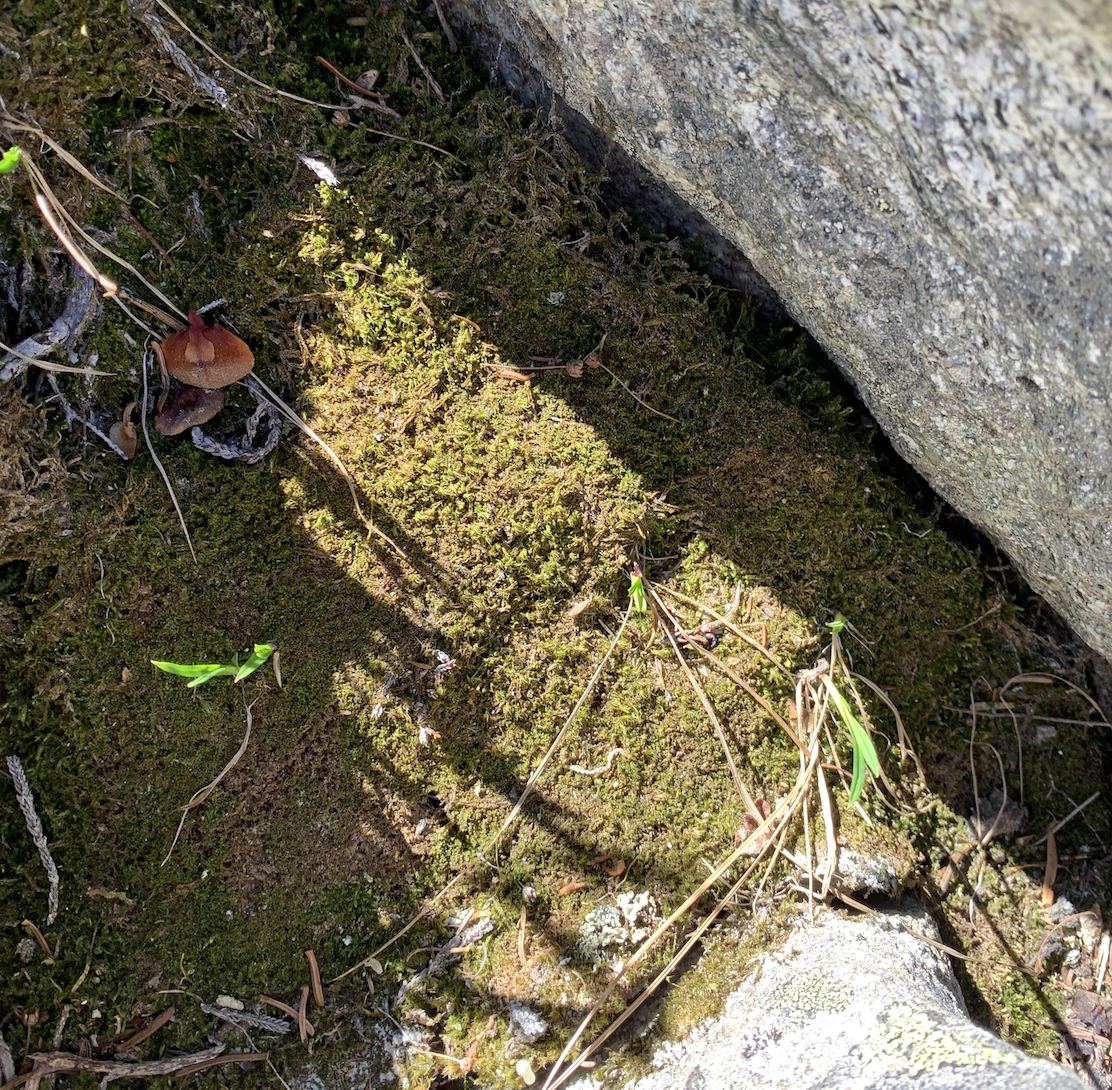
An occasional species of wet bedrock and streamside boulders, B. hatcheri forms variably erect to prostrate large green 4-lobed leafy shoots up to 5 cm tall and around 2 mm wide. The shoots are typically topped by abundant, densely-arrnaged and bright red clusters of asexual reproductive bodies (“gemmae”) that are quite diagnostic within this genus for our region. The lobes of the lateral leaves have sharp tips and descent to down between 20-40% of the leaf’s length. Underleaves are present, and the bases of the lateral leaves are marked by the presence of “cilia” (see photo).
Similar species
Species of Tritomaria typically have 3 lobes that are not symmetrical and the shoots are reclined. In Barbilophozia hatcheri, leaves are symmetrical with occasionally 3 but predominantly 4 lobes and the shoots are upright. Neoorthocaulis floerkii can have 4 symmetrical lobes, but it also has a prominent underleaf that is absent in B. hatcheri. Within the genus Barbilophozia, there is no other species so reliably laden with red gemmae.
Habitat
Moist to mesic humus, rock outcrops, boulders, decayed wood, streambanks, snowbed sites, heath, and tundra in the montane, subalpine, and alpine zones
Associated species
XXXXXX
Distribution Map
Relevant Literature
- Godfrey, J.D. (1977). Hepaticae and Anthocerotae of southwestern British Columbia . [Doctoral dissertation, University of British Columbia]. UBC cIRcle.
- Hong, W. S. (2007). Scapania. In Flora of North America Editorial Committee (Eds.), Flora of North America North of Mexico (Vol. 3) . Oxford University Press.
- Wagner, D. H. (2013). Guide to the liverworts of Oregon: Scapania undulata . Oregon State University Herbarium.